

How To Install Plastic Screw Hole Plugs
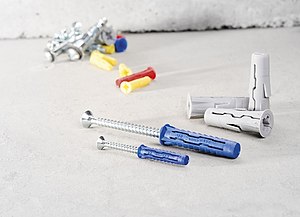
A wall plug (Uk English),[notes 1] likewise known as an ballast (US) or "Rawlplug" (UK), is a fibre or plastic (originally wood) insert used to enable the attachment of a spiral in material that is porous or breakable or that would otherwise not support the weight of the object attached with the screw.[1] [ii] It is a blazon of ballast that, for example, allows screws to be fitted into masonry walls. In Us English language, mentions of drywall anchors are sometimes meant (and taken) to refer specifically to the type of plastic wall plugs with expandable wings for hollow walls, in contradistinction with mollies and toggle bolts.
There are many forms of wall plug, just the nearly common principle is to use a tapered tube of soft material, such as plastic. This is inserted loosely into a drilled hole, then a screw is tightened into the centre. As the screw enters the plug, the soft textile of the plug expands conforming tightly to the wall cloth. Such anchors can attach one object to another in situations where screws, nails, adhesives, or other simple fasteners are either impractical or ineffective. Unlike types have unlike levels of strength and can be used on different types of surfaces.
History [edit]
Before commercial wall plugs, fixings were made to brick or masonry walls by chiselling a groove into a soft mortar articulation, hammering in a crude wooden plug and and then attaching to the wooden plug. This was time consuming and required a large hole, thus more than patching of the wall afterwards. Information technology too limited the holes' location to the mortar joints.
The original wall plug was invented by John Joseph Rawlings in 1911, and marketed under the name Rawlplug. These plugs became popular after the First Earth War, when a demand for retro-plumbing fixtures existing buildings with new electric lighting coincided with a shortage of labour, encouraging many new labour-saving innovations in the edifice trade. Rawlplug gained their prominence from their adoption in the British Museum.[3]
Early wall plugs were thick-walled fibre tubes, fabricated of parallel strings bonded with glue. The Rawlings brothers conducted thousand of trials using many diverse materials in their search for the perfect plug. Amongst the many solutions tested were plugs made of lead, zinc, natural and synthetic prophylactic, hemp fibres, drinking glass, wood, and paper. They imported Indian jute as it possessed natural resistance to the effects of humidity and for specially damp conditions they adult a range of white bronze plugs. Most current brands are plastic, first designed in 1958 by German inventor Artur Fischer, known every bit the Fischer Wall Plug.[4]
Other varieties of wall plug are mechanical anchors for heavy duty loads and hollow wall fixings for fixing to plasterboard. The commencement mechanical anchor, the Rawlbolt, was designed in the 1930s past the Rawlplug visitor and the first fixing for hollow walls was the Toggle Bolt, which was as well designed past Rawlplug in 1941.
Split-ribbed anchor [edit]
Blitheness of a wall plug. (The states: split-ribbed plastic anchor or conical anchor)
Nowadays, one of the most common designs for light loads is the split-ribbed plastic anchor. It consist of ii halves that increment their separation (split) as the spiral penetrates between them. As its name suggests, this type of anchor likewise has ribs on the outside to prevent the anchor from slipping out of the hole as the screw is driven in. This type of anchor is too known as a conical spiral anchor.[v]
Fibre and resin mixes [edit]
On crumbling walls it may be hard to drill a clean hole, or the force of the expanding plug may exist plenty to cause not bad. In these cases, a hardening liquid or putty mixture may be used instead.
Ane of the starting time of these mixtures was produced by Rawlplug and was equanimous of dry white asbestos fibres, sold loose in a tin. The user wetted some into a ball (ordinarily by spitting on them) and pushed this plug of putty into the pigsty. A small tamper and fasten was supplied with the kit. This putty worked very well, but the hazard of the asbestos fibres ways that the product is no longer bachelor. However, some other style to fix wall plugs is accomplished by the awarding of a cotton woven pad which has been impregnated with a special formulated gypsum to bond into the wall. The pad is wetted and wrapped around the wall plug, and the 2 are inserted into the pigsty; after a short time it hardens and a stiff bond is accomplished and the wall plumbing equipment can be applied. It is used in combination with wall plugs in masonry, ceramic, forest and plasterboard walls.
Modern resin mixtures are based on polyester resins. Apart from their use in structure, they're likewise used in climbing.
Hollow walls [edit]
There are special fasteners for hollow walls such equally plasterboard partitions, which are non thick plenty to take wall plugs. The fasteners have toggle arms, which either drop into identify or expand within the cavity, and a fixing screw which is threaded through them.
Expansion anchors [edit]

These are often called "lead anchors" or "plastic anchors", and are used as follows:[6]
- Drill a pigsty the same size as the anchor body.
- Push the anchor to its total depth in the hole.
- Insert the spiral through the item beingness fastened and screw it into the anchor tightly.
Other types [edit]
Anchors designed peculiarly for fastening to hollow walls, include toggle bolts and molly bolts. These wall anchors are besides known by other names, such as, "tacos", drywall hangers, expansion basics, etc.
Run into too [edit]
- Mechanical Plastics Corp.
- Well nut
Notes [edit]
- ^ In US English, a wall plug would likely exist understood equally an electric socket on a wall, although that is a misnomer as a socket is a device that accepts a plug.
References [edit]
 | Wikimedia Eatables has media related to wall plugs. |
- ^ Oxford Dictionaries
- ^ Company, Houghton Mifflin Harcourt Publishing. "The American Heritage Dictionary entry: dowel". ahdictionary.com . Retrieved 2017-05-09 .
- ^ "Rawlplug history". Rawlplug Ltd.
- ^ "Artur Fischer, Inventor With More Patents Than Edison, Dies at 96". William Grimes. The New York Times. viii February 2022. Retrieved 6 March 2022.
- ^ Marker W. Huth (2015). Residential Structure Academy: Basic Principles for Construction. Cengage Learning. p. 215. ISBN978-i-305-53729-3.
- ^ "Hold It!". Popular Mechanics. Hearst Magazines. 146 (3): 120–122. 1976.

Source: https://en.wikipedia.org/wiki/Wall_plug
Posted by: hatchetthimpeas.blogspot.com
0 Response to "How To Install Plastic Screw Hole Plugs"
Post a Comment